
Treatment for the back, lower back and joints
When back pain, stiffness or reduced mobility is the clear primary concern.
Read about Treatment for the back, lower back and jointsBack pain
Back pain can take up a surprising amount of space in everyday life.
Perhaps you notice it when getting out of a chair. Turning in bed. Bending down, exercising or going for a longer walk.
Or perhaps there is no single movement.
Your back has simply become something you constantly have to take into account.
I work with manual treatment and assessment of back-related concerns, focusing on movement, tension patterns and function.
The question is not only where it hurts – but also what the pain is stopping you from doing.
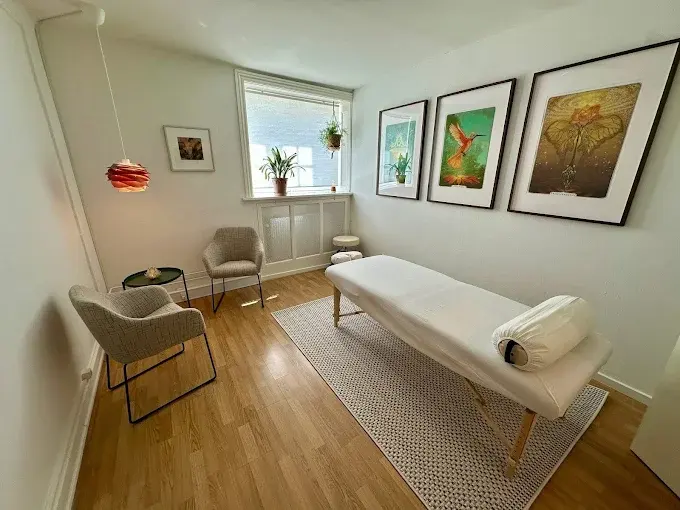
Does this sound familiar?
For some people, it is local soreness or tension.
For others, the back feels stiff, tired or restricted.
Some notice symptoms mainly after sitting for a long time. Others when standing, walking, lifting or exercising.
And for some, the symptoms come and go:
“It gets better – and then it comes back again.”
You may experience:
So the interesting part is not simply that your back hurts. It is how your particular back responds.
A question with more than one possible answer
Back pain can arise in many different situations.
Sometimes there is a clear beginning – a lift, unfamiliar load, sport or a sudden movement.
At other times, it develops gradually.
Load, mobility, muscular tension, previous problems and changes in the way the body moves may all be relevant parts of the picture.
But I do not assume that everything is connected, or that every episode of back pain has one hidden “root cause” waiting to be discovered.
We first look at what actually appears relevant in your situation.
Assessment before formula
I begin by asking what has happened.
Depending on the concern, I then look at relevant movements and areas and assess mobility, tension patterns and function.
Only then does it make sense to decide how I will work manually.
That also means that two clients with pain in the same place will not necessarily receive the same treatment.
If your lower back hurts, the lower back is of course relevant.
But depending on what I find, it may also make sense to look at movement or tension around the pelvis, hips or other nearby areas.
Not because we decide in advance that the problem “comes from somewhere else”.
But because the body may change the way it moves and loads when something hurts or has been restricted for a longer period.
So I do not automatically work away from the painful area – and I do not automatically work only there.
We follow what appears relevant.
Movement & confidence
When your back has hurt for some time, it is easy to start monitoring every movement.
How should I sit?
Can I bend?
Is lifting dangerous?
Do I need to keep my back perfectly straight?
It is understandable to become more cautious when a movement has hurt before.
But the goal is not for you to become an expert at protecting your back all day.
The goal is for movement to gradually feel more natural and less like something that constantly needs to be controlled.
Where relevant, we therefore also talk about movement, load and what you can begin to use your body for again.
Everyday function
Less pain can of course matter.
But I also want to know what a change means for you.
Being able to:
That is often where change becomes truly relevant.
When your back starts taking up less space in your decisions.
Next step
When back pain, stiffness or reduced mobility is the clear primary concern.
Read about Treatment for the back, lower back and jointsIf this is your first visit, the concern is unclear, symptoms have changed or you simply do not know what to choose.
Start with an assessmentMay be relevant for longstanding or more complex concerns where several areas or movement patterns need to be considered.
Read about integrative treatmentStill unsure? Start with the assessment. Choosing the right technique in advance is not your job.
Professional boundaries
Manual treatment may be relevant for many back-related concerns, but not every symptom should be assessed or treated manually as the first step.
If your symptoms are new or unusual, very severe, follow significant trauma or occur together with other concerning symptoms, medical assessment may be appropriate.
If anything in your history or presentation makes me uncertain whether manual treatment is the right next step, I will tell you.
Part of working professionally with back pain is also knowing when not to treat.
No. You do not need a diagnosis to book an appointment with me. If your concern requires medical assessment or further investigation, I will recommend that.
If you have a clear back- or joint-related concern and know what you want to book, Treatment for the back, lower back and joints may be relevant. If this is your first visit or you are unsure, an Initial consultation and assessment is a good place to start.
A known disc herniation does not necessarily mean that manual treatment is ruled out, but symptoms, stage and the individual situation need to be assessed. With new or changing neurological symptoms, medical assessment may be necessary.
I cannot decide that from a symptom or diagnosis alone. Some concerns respond relatively quickly, while others need a longer course. We assess progress along the way rather than deciding a fixed number of treatments in advance.
No. Intensity can be a tool, but more pain does not automatically mean better treatment. Treatment is adapted to the concern, the tissue and your response.
It depends on your situation, the symptoms and the activity you want to do. The goal is not necessarily to avoid all movement, but to find a level and load that makes sense for you.
Ready for the next step?
You do not need to know exactly why it hurts.
And you do not need to choose the correct treatment technique yourself.
Tell me what you feel, when you feel it and what your back has started preventing you from doing.
We can start there.